02 — SEARCH FOR A PUPPY
How to Find the Right Rottweiler Puppies for Sale
Once you have decided that the Rottweiler is the right breed for you, the search becomes much more complicated. Type Rottweiler puppies for sale into Google and you can find hundreds of websites, breeders, advertisements and puppies—often with dramatically different prices, pedigrees, health testing and claims of quality.
So how do you determine which Rottweiler puppies for sale deserve serious consideration?
Start by changing the way you search. Instead of asking “Who has a Rottweiler puppy available near me?” ask “Who is producing the type of Rottweiler I actually want to live with?”
Location is temporary. The dog you choose could be part of your family for the next decade or longer.
Price, Location or Breeder: What Should Matter Most?
Price and location are two of the easiest things to compare when searching for Rottweiler puppies for sale, which is exactly why people tend to focus on them first.
But neither tells you very much about the puppy.
A puppy located twenty minutes from your home is not automatically a better choice than one located 1,000 miles away. A $2,000 puppy is not necessarily a bargain, and a $7,000 puppy is not automatically superior simply because it costs more.
The breeder, the breeding decisions behind the litter, the health of the parents, temperament, pedigree, early development and the breeder's ability to match the puppy to your household can matter far more than distance.
The goal is not to find the closest Rottweiler puppy for sale. The goal is to find the right Rottweiler.
Temperament Should Be One of Your First Priorities
When comparing Rottweiler puppies for sale, temperament should never be treated as an afterthought. A beautiful puppy with impressive parents may still be completely wrong for your household if the temperament and drive do not match the life you intend to provide.
Ask yourself what you actually want your adult Rottweiler to do.
If you want a family companion that travels with you, spends time around visitors, accompanies you in public and relaxes in the house with your family, your priorities may be very different from someone who plans to train several times a week for protection work or compete in working trials.
Do You Really Want a High-Drive Rottweiler?
“High drive” can sound impressive when reading descriptions of Rottweiler puppies for sale. For the right owner with specific training goals, drive can be extremely desirable. But more drive does not automatically mean a better Rottweiler.
A highly driven working dog generally needs an appropriate outlet for that drive. Training, structure and mental engagement are not optional simply because the owner becomes busy.
If your primary goal is a family companion, do not assume you need the most intense puppy in the litter or parents selected primarily for extreme working characteristics.
Choose the temperament for the life you actually live—not the life that sounds impressive on paper.
What Do Working Titles on the Parents Actually Tell You?
Working titles can demonstrate valuable qualities. Depending on the discipline, they may provide evidence of trainability, confidence, drive, obedience and the dog's ability to perform under pressure.
But when comparing Rottweiler puppies for sale, a long list of working titles should not automatically cause you to conclude that those puppies are the best choice for your family.
Ask what those accomplishments mean for the breeding and what characteristics the breeder expects the parents to produce.
An experienced breeder should be able to explain not only what the titles mean, but whether the resulting puppies are appropriate for your goals.
What Do Show Titles Tell You About the Parents?
A successful show career requires much more than an attractive dog.
A Rottweiler competing successfully must tolerate transportation, unfamiliar environments, crowds, physical examination by judges, handling, noise and the presence of many other dogs. The dog must repeatedly function in those environments while remaining manageable.
Show success also represents substantial investment. Campaigning a dog can involve entry fees, travel, professional handling, conditioning and countless hours of work.
When evaluating Rottweiler puppies for sale from accomplished show parents, those achievements give you useful information about the breeder's investment in the dogs and provide additional opportunities for the parents to be evaluated outside their own backyard.
Why Health Certifications Matter When Comparing Rottweiler Puppies for Sale
Health testing is one of the areas where the difference between breeders can become significant.
Responsible breeding does not mean simply taking two Rottweilers that appear healthy and producing puppies. Certain hereditary conditions cannot be evaluated by looking at a dog, watching it run or relying on the fact that it has never shown symptoms.
That is why health certifications matter when evaluating Rottweiler puppies for sale.
For Rottweilers, breeders may screen breeding dogs for areas such as hips, elbows, cardiac health, eyes and breed-relevant genetic conditions. The specific testing performed can vary, but the important question is simple:
What objective health information does the breeder have about the parents before deciding to breed them?
Health Testing Costs Money—and That Matters
Proper health screening requires time, veterinary appointments, testing fees and, in many cases, evaluation by specialists or recognized health organizations.
That investment does not guarantee that a puppy will never experience a health problem. No responsible breeder can honestly make that promise.
What it does demonstrate is that the breeder gathered information that could help make a more informed breeding decision.
When you find very inexpensive Rottweiler puppies for sale, ask what expenses may have been avoided to make that price possible. Were both parents health tested? Were those results independently documented? Were the parents carefully selected, or were they simply two available Rottweilers?
A lower purchase price can be attractive, but purchase price represents only a fraction of what you may spend during the lifetime of your dog.
Ask to See the Health Results—Not Just the Words “Health Tested”
“Health tested” is easy to write on a website.
Documentation is more meaningful.
When researching Rottweiler puppies for sale, ask which tests were performed on the sire and dam and whether the results can be verified. A breeder should be able to explain what testing was completed and why those tests were important to the breeding decision.
Also distinguish between a routine veterinary examination and breeding-specific health screening. A veterinarian saying that a dog appears healthy during an examination is not the same thing as evaluating that dog for hereditary conditions relevant to a breeding program.
Health Certifications Reduce Risk—They Do Not Eliminate It
Dogs are living animals, and genetics are complicated. Even carefully planned litters from health-tested parents cannot come with an absolute guarantee that every puppy will remain free of every medical condition throughout life.
The purpose of health screening is risk reduction and better-informed breeding decisions, not certainty.
Be cautious of anyone offering Rottweiler puppies for sale who promises that their puppies can never develop a health problem. Responsible breeding should be based on transparency, documentation and informed decisions—not impossible guarantees.
What Should You Ask About the Parents?
- What health testing was completed on the sire?
- What health testing was completed on the dam?
- Can the results be independently verified?
- How old are the parents?
- What are their temperaments like in everyday life?
- Why were these particular two Rottweilers bred together?
- What strengths was the breeder hoping to preserve or improve?
- Are there known health or longevity trends in the pedigree?
- What type of temperament does the breeder expect from this litter?
- Are these puppies primarily suited for companionship, showing, working, or a combination?
Why Do Prices for Rottweiler Puppies for Sale Vary So Much?
One breeder may advertise Rottweiler puppies for sale for $1,500 while another asks $10,000. At first glance, especially when the puppies look similar in photographs, that difference can be difficult to understand.
The mistake is assuming that you are simply comparing the price of one puppy with the price of another puppy.
You may actually be comparing two completely different breeding programs.
The purchase price can reflect years of investment made long before the litter was born: acquiring breeding-quality dogs, importing dogs or semen, health testing, training, showing, working, professional evaluations, veterinary care, pedigree research, reproductive expenses, puppy development and the breeder's experience selecting combinations.
Price alone proves nothing about quality. But quality breeding is rarely inexpensive to produce.
What Are You Actually Paying for When You Buy a Rottweiler Puppy?
When evaluating Rottweiler puppies for sale, look beyond the puppy standing in front of you.
You are also evaluating what happened before that puppy existed.
Did the breeder purchase the nearest available male and female, or spend years developing a breeding program? Were breeding dogs selected because they complemented one another? Were dogs imported to introduce particular bloodlines? Were parents health tested? Were they evaluated through shows, working events or other objective venues? Was temperament considered when planning the breeding?
None of those things can be seen in an eight-week-old puppy photograph.
Yet they may represent a significant part of what produced that puppy.
Why Accomplished Parents Can Make Rottweiler Puppies More Expensive
Producing accomplished breeding dogs can require substantial investment.
A breeder may purchase or import a promising dog and then spend years developing, conditioning, training, traveling and competing with that dog. Some breeding dogs represent tens of thousands of dollars in acquisition, travel, training, showing and related expenses before they ever produce a litter.
That does not mean an expensive parent automatically produces exceptional puppies.
It does mean that when comparing prices for Rottweiler puppies for sale, you should understand that breeders may have dramatically different levels of investment behind their litters.
The puppy price is not simply based on food consumed during the first eight weeks of life.
Does a Higher Price Guarantee a Better Rottweiler Puppy?
No.
This is just as important as understanding why quality breeding can be expensive.
A breeder can charge a high price without providing meaningful health testing, thoughtful breeding decisions, accomplished parents, quality puppy development or long-term support. A high price is not evidence by itself.
Likewise, a lower price does not automatically mean that a puppy is unhealthy or poorly bred.
Price is information—not proof.
When comparing Rottweiler puppies for sale, determine what supports the price. Ask questions. Review the parents. Verify health information. Learn about the breeder's experience. Understand what was invested into the breeding and what support exists after the puppy leaves.
The Cheapest Rottweiler Puppy Can Become the Most Expensive
Saving money on the purchase price can feel important today. But the purchase price becomes increasingly insignificant when spread across the lifetime of a dog.
Veterinary treatment for orthopedic problems, chronic illness or other significant medical conditions can cost thousands of dollars. Training for serious behavioral problems can also become expensive—and some problems cannot simply be solved by spending more money later.
Health-tested parents and careful breeding cannot eliminate every risk. But choosing solely according to the lowest advertised price ignores many of the factors breeders can evaluate before producing a litter.
When you compare Rottweiler puppies for sale, ask yourself a better question than:
“Which puppy costs the least?
”Ask:
“What am I receiving for the price, and what evidence supports it?”
Compare Value, Not Just Price
The best value is not necessarily the least expensive puppy or the most expensive puppy.
Value is the combination of the qualities that matter to you: appropriate temperament, thoughtful breeding, documented health screening, quality parents, responsible early development, breeder experience, transparency and support.
Two advertisements may both say Rottweiler puppies for sale, but the programs behind those puppies may have almost nothing else in common.
That is why your research should never stop at the number beside the puppy.
How to Evaluate a Breeder Offering Rottweiler Puppies for Sale
Once you find Rottweiler puppies for sale that interest you, stop looking only at the puppies.
Start investigating the person who produced them.
A breeder influences far more than the first eight weeks of your puppy's life. Breeding decisions determine the parents. The breeder controls early nutrition, environment, veterinary care, socialization and development. An experienced breeder may also become an important resource long after your puppy goes home.
A beautiful website does not prove someone is a good breeder. Neither does a large social-media following.
Look for substance behind the presentation.
Red Flags When Looking at Rottweiler Puppies for Sale
No single detail automatically proves that a breeder should be avoided, but certain patterns deserve additional questions.
- The breeder cannot clearly identify or discuss both parents.
- Health testing is claimed but no specific testing or documentation is provided.
- Every puppy is described as perfect for every type of household.
- The breeder asks almost nothing about you or the home the puppy will enter.
- The breeder cannot explain why the sire and dam were paired.
- Puppies appear to be produced primarily according to availability rather than a breeding plan.
- The breeder makes absolute guarantees that a puppy will never develop a health problem.
- You receive little information about temperament or differences between individual puppies.
- Pressure is placed on you to send money immediately before asking questions.
- The breeder seems unwilling to remain available after the puppy leaves.
Green Flags When Comparing Rottweiler Breeders
Now look for evidence that the breeder has a deliberate process rather than simply puppies available.
- The breeder can explain the strengths and weaknesses of the parents.
- Health testing is discussed specifically and documentation is available.
- Temperament is treated as seriously as appearance.
- The breeder asks questions about your household, experience and expectations.
- The breeder is willing to tell you when a particular puppy may not be right for you.
- The breeder can explain the purpose behind the breeding.
- Puppies receive deliberate early care, handling and development.
- The breeder discusses realistic expectations rather than promising perfection.
- There is a written agreement explaining responsibilities and expectations.
- Support continues after the puppy goes home.
A Good Breeder May Ask You Almost as Many Questions as You Ask Them
Do not be offended if a breeder offering Rottweiler puppies for sale wants to know about your experience, household, children, other animals, lifestyle, training plans and expectations.
That can be a very good sign.
A responsible breeder is not simply trying to determine whether you can pay for the puppy. They should care whether the puppy fits your household.
This becomes especially important with Rottweilers because temperament, confidence, energy and drive can vary even among puppies in the same litter.
The puppy you think is the cutest may not be the puppy that fits you best.
Questions to Ask Before Buying a Rottweiler Puppy
- Why did you choose this sire and dam?
- What are the temperaments of both parents?
- What health testing has been completed?
- Can I verify those results?
- What do you know about health and longevity in the pedigree?
- How are the puppies raised during their first weeks?
- How are the puppies socialized and exposed to new experiences?
- How do you evaluate individual puppy temperaments?
- How do you determine which puppy is appropriate for each household?
- What vaccinations and veterinary care will the puppy receive?
- What documentation comes with the puppy?
- What does your contract require from me?
- What support do you provide after the puppy goes home?
- What happens if circumstances prevent me from keeping the dog later in life?
Pay Attention to the Questions the Breeder Asks You
The interview should work both ways.
When someone advertises Rottweiler puppies for sale without caring where those puppies go, you learn something about the priorities of that breeding program.
A breeder does not need to interrogate you, but they should want enough information to make an informed placement.
If you tell a breeder that you want a quiet family companion and they immediately recommend their most intense, highest-drive puppy simply because that puppy is still available, ask yourself whose interests are driving the recommendation.
A thoughtful breeder should sometimes be willing to say:
“This puppy is not the right puppy for your family.”
That answer may be more valuable than an immediate yes.
Who Should Evaluate the Rottweiler Puppy You Bring Home?
After carefully researching breeders and Rottweiler puppies for sale, many families make one final mistake: they assume they should personally evaluate the litter and determine which puppy is best.
But ask yourself an important question:
What qualifies you to evaluate an eight-week-old Rottweiler puppy?
Owning dogs—even owning several Rottweilers—does not necessarily give someone the experience required to accurately evaluate a litter of young puppies.
The breeder has an enormous advantage that you do not.
An experienced breeder has watched those puppies develop from birth. They know the sire and dam. They know their bloodlines. They may know multiple generations behind the litter. They have observed the puppies interacting with littermates, people, unfamiliar situations and their environment over many weeks.
You may meet them for an hour.
Those two perspectives are not equivalent.
“I Let the Puppy Pick Me” Is Not a Temperament Evaluation
Almost every experienced breeder has heard some version of this story:
“My last dog picked me.”
Perhaps the puppy climbed into the person's lap, followed them around or seemed more interested in them than the other puppies. That dog later became wonderful, so the family naturally associates that first interaction with having chosen the right puppy.
It is a wonderful memory.
It is not necessarily evidence that the puppy selected the appropriate home.
A puppy may approach you first because it happens to be awake while another puppy is tired. The most confident puppy may immediately investigate a stranger. Another excellent puppy may be distracted by a toy. A puppy that normally seeks attention may have just eaten and prefer to sleep.
A brief interaction is a snapshot.
When choosing among Rottweiler puppies for sale, a professional breeder's observations across many weeks provide substantially more information than a few minutes spent watching puppies during a visit.
Choose the Breeder Before You Choose the Puppy
This is why choosing the breeder carefully is so important.
You should select a breeder whose experience, breeding philosophy and judgment you trust enough to listen when they describe the individual puppies.
The breeder should be able to explain differences in confidence, energy, drive, independence, sociability and other characteristics they have consistently observed.
More importantly, the breeder should understand your household and expectations well enough to interpret those differences in relation to you.
When considering Rottweiler puppies for sale, your goal should not simply be:
“Which puppy do I like best?”
A better question is:
“Based on what you know about my family and what you have observed in this litter, which puppy or puppies do you believe fit us best—and why?”
Professional Puppy Matching Does Not Remove Your Choice
Working with the breeder does not mean your preferences are irrelevant.
You may have preferences regarding sex, appearance, personality or other characteristics. Those preferences should be discussed openly.
But there is an important difference between having preferences and assuming you can evaluate a litter more accurately than the person who bred and raised it.
A responsible breeder should explain their findings, identify the puppies they believe are appropriate for your household and help you understand the reasoning behind those recommendations.
The final decision can still involve you.
It simply becomes an informed decision instead of a guess based on which puppy happened to crawl into your lap.
The Best Rottweiler Puppy Is the One That Fits Your Home
There is no single “best puppy” in a litter.
There may be a puppy best suited for a particular family, another better suited for an experienced working home and another whose characteristics make it especially promising for showing or breeding.
That is why concepts such as “first pick” can be misleading when comparing Rottweiler puppies for sale.
Being allowed to choose first does not automatically mean you receive the puppy best suited for you.
The best puppy is not necessarily the puppy everyone else would choose first. It is the puppy whose temperament and characteristics best complement the home in which it will live.
Before You Commit to a Rottweiler Puppy for Sale
You have researched the breed, evaluated the breeder, reviewed the parents and health information, discussed temperament and received guidance about which puppies may fit your household.
Now slow down one more time before sending a deposit or signing an agreement.
Buying a Rottweiler puppy should not feel like a race against another person with a credit card.
Make sure you understand exactly what you are agreeing to.
Understand the Deposit Before You Pay It
Breeders offering Rottweiler puppies for sale may structure deposits differently. A deposit might reserve a specific puppy, establish selection priority within a litter, secure a position on a waiting list or represent a commitment to the breeder's program rather than one particular puppy.
Never assume.
Before paying, understand:
- What exactly does the deposit reserve?
- Is the deposit refundable or nonrefundable?
- What happens if the planned breeding does not occur?
- What happens if there is not an appropriate puppy for your household?
- Can the deposit transfer to another litter?
- How is puppy selection or placement order determined?
- When is the remaining balance due?
Read the Contract Before Pickup Day
Do not wait until you are excitedly preparing to leave with your puppy before reading the agreement.
A breeder's contract may address registration, breeding rights, spaying or neutering, health provisions, veterinary requirements, ownership transfer, return policies and other responsibilities.
When comparing Rottweiler puppies for sale, ask to understand the breeder's requirements before making your final commitment.
If something is unclear, ask.
Confirm What Comes With Your Rottweiler Puppy
Before bringing your puppy home, know what documentation, veterinary care and information you should expect to receive.
Depending on the breeder and puppy, this might include registration documentation, vaccination and deworming records, veterinary records, microchip information, feeding instructions, the purchase agreement and other relevant records.
You should also know what food the puppy currently eats and what routine the breeder has established.
Plan Pickup or Transportation Before the Last Minute
The best Rottweiler puppies for sale for your household may not be located nearby.
If travel is required, discuss transportation arrangements early. Determine whether you will pick the puppy up personally, meet the breeder at an agreed location or use another transportation arrangement offered or approved by the breeder.
Ask how long the trip will take, what the puppy needs during travel and what you should bring.
Then prepare your home before your puppy arrives.
What Should You Buy Before Bringing Your Rottweiler Puppy Home?
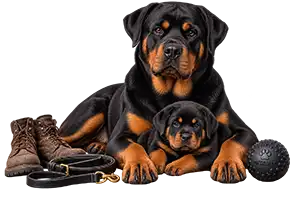
You do not need a house full of puppy products. You need the right basics ready before your puppy arrives.
- Appropriately sized crate with room to grow or a divider
- Durable food and water bowls
- The same puppy food currently being fed by the breeder
- Flat buckle collar
- Standard leash
- Identification tag
- Safe, durable puppy toys
- Appropriate chew items
- Training treats
- Washable bedding or crate pad
- Enzymatic cleaner for house-training accidents
- Waste bags
- Grooming brush
- Dog shampoo appropriate for puppies
- Nail-care supplies
- Toothbrush and dog-safe toothpaste
- Secure vehicle restraint or travel crate
- Baby gates if certain areas of the home will be restricted
What Should You NOT Buy Yet?
Avoid buying every product marketed to puppy owners before you know whether you actually need it.
Your Rottweiler puppy will grow quickly. Expensive collars, beds and other size-dependent items may have a very short useful life.
You also do not need dozens of toys. A smaller selection of appropriate toys that can be rotated is often more useful than overwhelming a puppy with everything at once.
Most importantly, equipment does not raise a puppy.
The most valuable things you can have ready are a plan, consistent household rules, time for training and agreement among family members about what will and will not be allowed.
You Found Your Rottweiler Puppy. Now the Real Work Begins.
The search through Rottweiler puppies for sale is over.
You researched the breed. You chose the breeder. You considered health, temperament and breeding decisions. You found a puppy appropriate for your household. Your supplies are ready.
Now that puppy is coming home.
What happens during the first days, weeks and months can establish habits that influence your relationship for years.
The next section begins the moment your Rottweiler puppy walks through your door.